
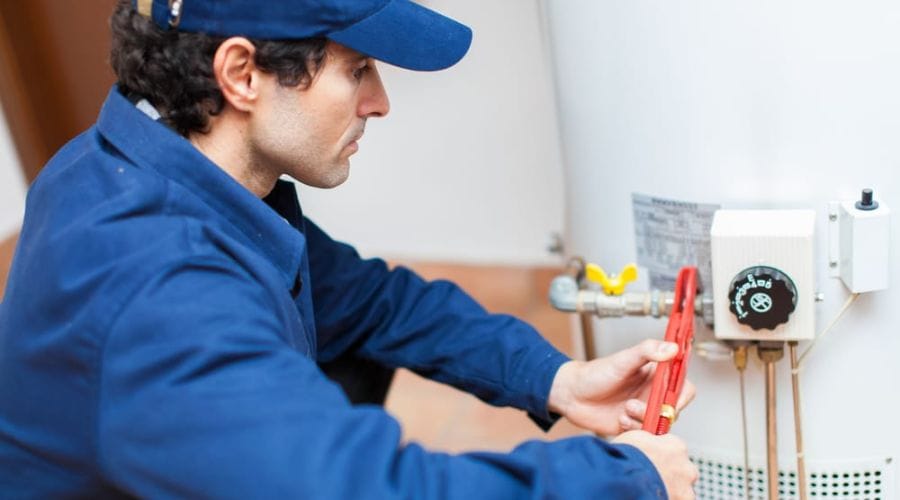
If your South Jordan home has a water heater popping or rumbling each time it heats, minerals are usually piling up on the tank bottom. It often starts as a few ticks after a long shower and grows into a steady crackle. The sound itself is rarely the hazard. Here is what causes it, what you can check, and when it points to a failing tank.
What Causes a Water Heater Popping Sound
Hard water carries dissolved calcium and magnesium. The USGS explains that when hard water is heated, as it is in a home water heater, solid calcium carbonate deposits can form. That scale coats the tank walls, flakes off, and settles on the bottom with sand and grit.
On a gas water heater, the burner sits under the tank and heats the water through the steel bottom. Water trapped under the crusty layer gets hotter than the water above it and flashes into steam. Those bubbles force their way up through the sediment, and each one makes a small pop. One manufacturer's service guide describes droplets of water bubbling through lime formations and sediment while the burner is on.
Electric tanks heat with an upper and a lower element that sit in the water. Scale forms on the hot element sheath, and water boiling against that crust sounds like singing, hissing or crackling. The lower element can also end up buried in sediment, which makes it run hotter and can shorten its life.
What You Can Check Safely
You can learn a lot without opening anything. Note what you find:
- Timing: notice when the sound happens. Water heater popping that follows heavy hot water use, while the burner or elements run, points to sediment. A single bang when a faucet or washing machine valve shuts is water hammer in the pipes, not the tank.
- The base: run a dry paper towel around the tank bottom, the drain valve and the fittings on top. Moisture or rust streaks matter more than the noise does.
- The relief valve pipe: check the open end of the discharge pipe from the temperature and pressure relief valve for drips or white crust.
- The data label: find the model and serial number. Many makers code the manufacture date into the serial number.
- Hot water supply: notice whether showers run cool sooner than before. A thick sediment layer takes up room in the tank.
Flushing the Tank, and Where It Falls Short
Flushing is the usual first answer to water heater popping, since it drains loose sediment. Another manufacturer's noise guide suggests flushing at least once a year, and more often with hard water. The basic steps:
- Shut off the heat: set the gas control to pilot or vacation, or switch off an electric tank's breaker.
- Close the cold supply: close the valve on the cold inlet line.
- Drain: run a hose to the floor drain, open a hot faucet upstairs, then open the drain valve.
- Rinse and refill: open the cold supply in short bursts to stir the bottom, then close the drain and refill until the hot faucet runs steadily.
Flushing has limits. Hard scale often breaks into chips too large for a small drain valve, and plastic valves clog easily. The service guide linked above notes that a flush may not remove all the lime, so the noise can return. An old drain valve that has not been opened in years may not reseal.
When Water Heater Popping Means the Tank Is Failing
Popping on its own is usually a maintenance problem, not an emergency. Over time, though, sediment insulates the tank bottom from the water, so the steel there runs hotter. That stresses the steel and its glass lining and speeds up wear. Signs the tank itself is failing:
- Water at the base: a damp floor or a puddle under the tank often means the steel has started to leak.
- Sizzling on a gas unit: a sizzle near the burner can be water dripping onto the flame from a leak above it.
- Rusty hot water: rust-colored water from the hot taps only can point to corrosion inside the tank.
- Noise that returns quickly: a tank that turns loud again soon after a flush holds more hardened scale than a flush can reach.
Several of these signs on an older tank usually make replacement the better path than repair.
A South Jordan Scenario You Might Recognize
Picture a family whose basement gas water heater has started to rumble after the evening showers. The sound begins soon after the burner lights, builds into steady popping, and fades when the burner shuts off. Lately, the second shower runs cool sooner than it used to. The floor around the tank is dry, and the relief valve pipe shows no drips.
That pattern points to a thick layer of sediment on the tank bottom, not a leak. The water heater popping follows the burner cycle, and the shorter hot water supply fits a tank with less room for water. White chips in the bucket during a flush would confirm it. If dampness shows up at the base later, the picture shifts toward replacement.
Softening Water to Slow the Buildup
Hard water is common in northern Utah, and each tank of water that heats can leave more scale behind. A cation exchange water softener removes calcium and magnesium by trading them for sodium or potassium, according to the EPA. Softened water leaves much less new scale in the tank and on electric elements.
A softener does not dissolve scale already in the tank, so pair it with a flush or a new heater. The EPA also notes that softeners use water and salt to regenerate, so choose an efficient model set for your hardness. Towers Plumbing offers water softener service if you are weighing a system.
If you are replacing a noisy tank, a tankless water heater is another option. Hard water scales its heat exchanger too, so it still needs periodic descaling.
Safety Notes
- Gas smell, smoke or a CO alarm: get everyone outside, then call 911 or the gas utility's emergency line from outside.
- Scalding water: water from the drain valve and the relief pipe is hot enough to scald, so let the tank cool before draining and keep hands clear.
- Power off first: switch off the breaker before working on an electric tank, and do not restore power until the tank is full. An element that heats in air burns out.
- Leave the relief pipe open: never cap, plug or shorten the discharge pipe from the relief valve.
- Go easy on old valves: do not force a stuck drain valve or supply valve, since an old valve can break off.
When to Call a Professional
Call for help when water shows up at the base of the tank, when the relief valve drips or discharges, or when the drain valve will not close after a flush. Call as well if the popping returns soon after flushing, since hardened scale may be beyond a hose flush.
Replacing a scaled electric element means working near line voltage and draining the tank, so it is a job for a trained technician. Burner, gas control and venting problems belong with a professional too. If an older tank is showing several warning signs, Towers Plumbing can help you compare repair with water heater replacement.
Frequently Asked Questions
Is a water heater popping sound dangerous?
On its own, usually not. It means sediment is trapping steam on the tank bottom. The concern is long-term wear on the tank, so treat it as a reason to flush and inspect. Water at the base or a dripping relief valve calls for a faster response.
Will flushing stop the popping?
Often it quiets the tank for a while. Loose sediment drains out, but hardened scale may stay behind, and the noise can return. A softener slows how fast new scale builds up.
Why does my electric tank hiss instead of pop?
Its elements sit inside the water. Scale on an element makes water boil against a crusted surface, which sounds like hissing or singing. Cleaning or replacing the element may help, and that work requires the power off and the tank drained.
Plan Your Next Step
First, jot down a few details. Note whether the heater is gas or electric, when the noise happens, and whether it follows heavy hot water use. Add the age from the data label, the date of the last flush, and whether the home has a softener. Photograph the data label, too.
Towers Plumbing serves homes in South Jordan and nearby communities. When you are ready, send those notes through our contact page to schedule a visit. A technician can then confirm whether the water heater popping comes from sediment, scaled elements, or a tank near the end of its life.