
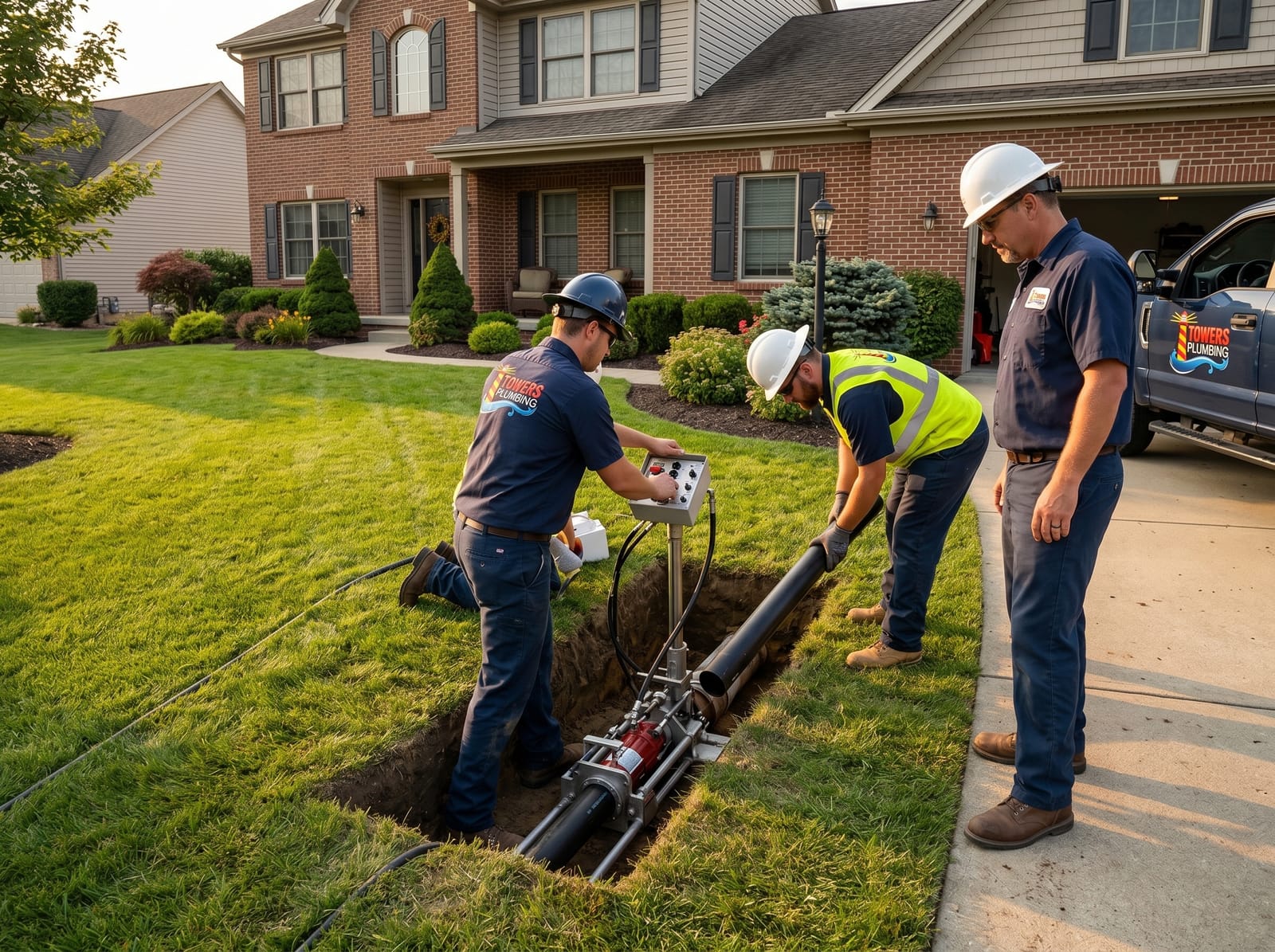
A floor drain that gurgles, a toilet that burps when the washer drains, a backup that returns months after the last clearing: these are common signs of tree roots in a sewer line. If your Sandy home has a large tree near the path of the main line, roots are a strong suspect. Here is how tree roots get in, what you can check safely, and what clears and repairs the line.
How Tree Roots Get Into a Sewer Line
The main sewer line carries household wastewater to the public sewer by gravity. Older lines were often built from short sections of clay, concrete or cast iron pipe joined end to end. Each joint can loosen as soil settles and the pipe ages.
Warm, moist air and a little wastewater escape through those gaps, and fine feeder roots follow that moisture to the joint. A review in the ISA journal Arboriculture and Urban Forestry notes that roots enter pipes at breaks and loose joints, then grow rapidly in the moist, nutrient-rich environment. It adds that clay and concrete pipe without rubber gaskets resists root intrusion the least.
Inside, the roots branch into a dense, hairlike mass that snags toilet paper and grease until the line backs up. In the dry Wasatch Front climate, a leaking joint gives roots a steady source of moisture through hot summers.
Signs to Watch For and What You Can Check Safely
Root problems build slowly, and the first symptoms usually appear at the lowest drains in the house.
- Slow drains: the basement shower or floor drain empties slowly while upstairs sinks seem fine.
- Gurgling: a toilet or floor drain gurgles when the washer pumps out or a full tub empties.
- Recurring backups: water rises at the floor drain and returns after a clearing.
- Odor: a sewer smell lingers around the floor drain or the cleanout.
Without opening anything, run the washing machine and watch the lowest drain. Note which fixtures slow down together. Several at once point to the main line rather than a single trap. Find the cleanout, a capped pipe often near the foundation or in the basement floor, but leave the cap on. Then note any large trees near the line's path to the street.
A Sandy Scenario You Might Recognize
Picture a Sandy family whose basement floor drain gurgles every time the upstairs washer pumps out. The basement shower has drained slowly for a few weeks. A large willow grows in the front yard, roughly between the house and the street. The line was cleared last spring, and the same symptoms are back.
That pattern points past any single fixture. Slow drains at the lowest level, gurgling during big discharges and a returning backup all suggest a partial blockage in the main line. The tree and the timing make tree roots at a joint the leading suspect.
Another clearing would open the line, but the recurrence says the entry point is still there. A camera inspection is the useful next step, because it shows the joint's condition and location so the family can weigh clearing against repair.
Finding and Clearing the Roots: Camera, Cutting and Hydro Jetting
A sewer camera inspection comes first when roots are suspected. A technician feeds a waterproof camera through the cleanout, and roots show up on the monitor as fibrous strands at the joints. The camera also reveals cracks, offset joints and low spots where water sits. A transmitter in the camera head, called a sonde, lets the technician find that spot from the surface and mark its depth.
Clearing often starts with a cable machine and a root-cutting head that cuts a path through the mass. Hydro jetting can follow or replace that step. A high-pressure water jet with a rotating nozzle cuts roots away from the pipe wall and flushes out the grease they were holding. A second camera pass confirms the line is open and shows how badly the joints are damaged.
Why Tree Roots Come Back
Cutting clears the inside of the pipe, but it does nothing to the tree or to the gap at the joint. The root stubs stay anchored in that opening, and the moisture that drew them in is still there. That is why lines with tree roots often need clearing again after a season or two.
Chemical root treatments can slow regrowth. The ISA review notes that herbicide foams have been used in sewer pipes, and that their use is restricted in many areas. Even when a treatment works, it does not seal the joint.
If the camera shows light intrusion at sound joints, planned maintenance clearing can be reasonable. If the joints are cracked, offset or separating, each cleaning buys time rather than solving the problem.
Repair Options When the Joints Are Broken
When the camera shows broken joints, main sewer line repair is the lasting route. It generally takes one of three forms.
- Spot repair: the crew excavates at the damaged joint and replaces that section, which fits when one or two joints are the problem.
- Trenchless lining: a resin-soaked liner is pulled into the cleaned pipe and cured in place. It forms a new pipe inside the old one, with no joints along its length.
- Replacement: when the pipe has collapsed or holds a low spot, a new line goes in by excavation or pipe bursting. A liner follows the old pipe's shape, so it cannot correct a sag.
NASSCO describes cured-in-place pipe as a way to rehabilitate gravity sewer pipe with cracks and leaks. Any digging starts with a locate request. Blue Stakes of Utah 811 asks for notice at least three business days before excavation, so buried utilities get marked first.
Safety Notes
- Stop using water during a backup: every flush or load of laundry adds to what comes up at the floor drain.
- Leave the cleanout cap on a backed-up line: wastewater standing in the pipe can push out as the cap loosens.
- Skip the rental root cutter: a cable machine can kink, whip and catch gloves or sleeves. It can also crack a fragile clay pipe.
- Avoid chemical drain openers: they do not remove roots, and they can splash back when the line is full.
- Keep people out of the wet area: keep children and pets away from an overflowed floor drain until it is cleaned up.
- Call before digging: contact Blue Stakes of Utah 811 before you dig to expose a line or plant a new tree.
When to Call a Professional
Call when several fixtures drain slowly at once, or when water appears at the floor drain while other fixtures run. A backup that returns after a clearing deserves a camera inspection, not just another round of cutting. A soggy patch or sunken strip along the line's path can also point to a leaking or broken pipe.
A camera inspection also makes sense before you buy an older home with mature trees, or before you plant near the line. The ISA review notes that tree roots are less likely to grow into sewer pipes when the tree stands about 20 feet (6 meters) or more from existing pipes. Towers Plumbing provides sewer and drain service in Sandy and can inspect the line, clear it and explain what the video shows.
Frequently Asked Questions
Can tree roots break a sound sewer pipe?
Rarely. The ISA review describes roots entering through breaks and loose joints that already exist. Once inside, the root mass holds those gaps open and keeps growing, so a small defect can become a recurring blockage.
Do I have to remove the tree?
Often not. Lining or replacing the damaged section removes the open joints the roots were using, and in many cases the tree can stay. Removal is a bigger decision, so talk with an arborist about the tree's health first. Roots already inside the pipe still need clearing either way.
Are newer plastic sewer pipes safe from roots?
PVC and ABS pipe with properly solvent-welded joints resists root entry far better than clay or concrete. A poorly sealed joint or a crack from settling can still let roots in, so symptoms still deserve a camera look.
Get Tree Roots in Your Sewer Line Checked
Before you call, jot down a few details about the problem. Note which drains back up, what was running at the time and whether the floor drain was involved. Write down when the line was last cleared and how long the relief lasted. Mark any large trees near the path to the street, and note where the cleanout is.
Then reach Towers Plumbing through our contact page to schedule a sewer camera inspection. With your notes in hand, a technician can go straight to the likely joint. You can watch the video together, see exactly where the roots are entering, and talk through clearing and repair options before any work begins.