
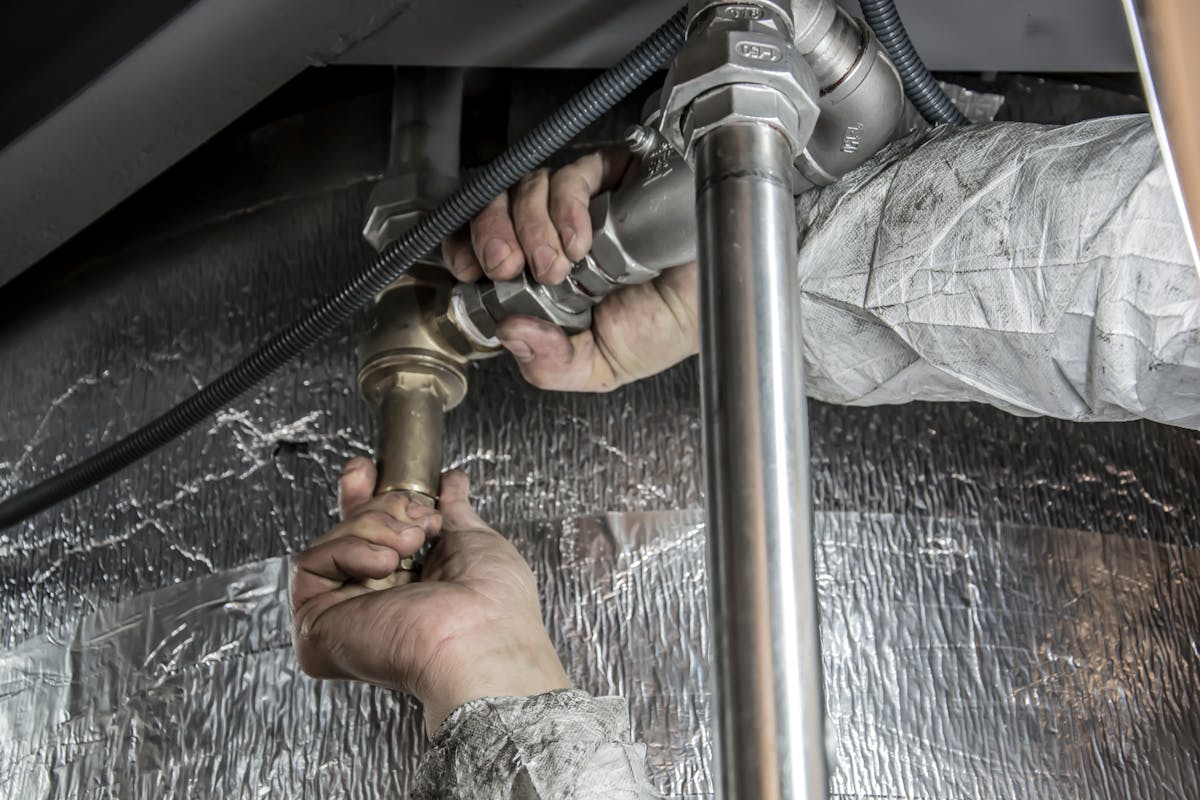
A refrigerator water line hides behind the fridge, feeds the ice maker and dispenser, and stays under pressure all day. When it fails, the first sign in a Kaysville home might be a damp grille, a floor board that starts to lift, or a brown ring on the basement ceiling. Here is how these lines fail, what you can check, and when the line and valve should be replaced.
How a Refrigerator Water Line Fails
The line runs from a cold water pipe to the water inlet valve on the back of the fridge. That small electric valve opens when the ice maker or dispenser calls for water. The tubing between the two stays under household pressure day and night, so any weak spot has steady force behind it.
Three kinds of tubing show up behind refrigerators:
- Thin plastic tubing: common in older ice maker kits, it hardens with age, creases easily and can split at a fold or pull loose from a fitting.
- Soft copper: copper holds up well, but each bend stiffens it, and a coil flexed every time the fridge moves can crack.
- Braided stainless connectors: these resist kinks. Their weak points are the crimped ends and the rubber washers inside each nut.
One manufacturer's water line guide calls for soft copper or PEX tubing between the shutoff valve and the refrigerator.
Saddle Valves Versus Proper Shutoff Valves
Many ice maker lines were tapped in with a saddle valve. It clamps around a copper pipe, and turning the handle drives a needle through the pipe wall, with only a rubber gasket to seal the tap.
Over time the gasket hardens, the clamp loosens, and the valve stem can weep. The same guide warns against piercing-type saddle valves because they reduce water flow and clog more easily. Another manufacturer's support page says self-piercing valves do not leave a large enough opening. Hard water is common in northern Utah, and mineral scale can narrow a hole that small.
A proper shutoff is a tee cut into the cold water pipe with a quarter-turn valve on the branch. It may sit in a recessed ice maker box behind the fridge, or on a dual-outlet angle stop under the kitchen sink. It closes fully and is easy to reach when a refrigerator water line starts to leak.
Kinks, Filter Housings and Other Weak Spots
Damage often happens when the fridge gets pushed back after cleaning or a floor project. The refrigerator water line gets pinched against the wall or caught under a roller or leveling leg. A kink cuts the flow, as that first guide notes, and a creased plastic line can split at the fold days later.
Other leak points sit close by:
- Inlet valve connection: the compression nut at the inlet valve can loosen when the fridge is moved.
- Inline filter: a filter spliced into the line adds two more joints, and its housing can crack.
- Internal filter housing: a cartridge that is not fully seated can drip inside the fridge or down behind the grille.
A cracked filter head or a leaking fill tube inside the unit is an appliance repair, not plumbing, so note which side of the inlet valve the water starts on.
Water Under the Fridge or in the Ceiling Below
On the main floor, look for water at the front grille, a dark stain along the side of the fridge, or floor boards that cup at the seams. Laminate and wood can swell well before a puddle appears.
Many northern Utah homes have a basement under the kitchen. A slow drip from a refrigerator water line can soak through the subfloor and show up downstairs first, as a stain, sagging drywall or drips. Water can travel along a joist before it drops, so the stain may not sit right under the fridge.
A dry kitchen floor above a stained ceiling can also mean another pipe in the same joist space. When the source is not clear, professional leak detection can help pinpoint it before more of the ceiling gets opened.
What You Can Check Safely: Shut Off and Dry
- Turn off the ice maker: use its switch or shutoff arm, per the owner's manual.
- Close the supply valve: look behind the fridge, under the kitchen sink and along the basement ceiling below. If you cannot find it or it will not close, shut off the main water valve.
- Pull the fridge out slowly: roll it straight out with a helper so the line does not snag.
- Look over the line: check for a split, a crease, white crust or wet fittings. If nothing is obvious, open the valve briefly with dry paper towels under each joint.
- Dry the area fast: run towels and fans on every wet surface.
The EPA's guide to mold and moisture says drying wet materials within 24 to 48 hours helps prevent mold growth.
A Kaysville Scenario You Might Recognize
Picture a family whose ice cubes have turned small and hollow over the past week. Then a brown ring shows up on the basement ceiling, a few feet from where the fridge sits upstairs. The kitchen floor looks dry, but the grille at the bottom of the fridge feels damp. A couple of weeks earlier, they pulled the fridge out to mop behind it.
That pattern points to the refrigerator water line, not the pipes in the wall. Small, hollow cubes suggest the ice maker is short on water, which fits a line that got kinked when the fridge went back. The slow leak suggests the kink cracked, or the nut at the inlet valve was strained loose. On hot July days a household may use more ice, so the fill valve opens more often.
Safety Notes
- Get help moving the fridge: a full refrigerator is heavy and can tip or gouge the floor.
- Mind a wet floor: water on vinyl, tile or wood is slippery, so dry a path first.
- Do not force old valves: a corroded saddle valve can snap or leak at the stem if you crank it. Use the main shutoff instead.
- Skip piercing valves: a new saddle valve as a quick fix brings back the same weak point.
- Watch the ceiling below: drywall that sags is holding water and can come down. Keep people out from under it.
- Dry before you close up: the EPA's mold cleanup guidance notes that porous materials such as ceiling tiles and carpet may have to be thrown away if they become moldy.
When to Call a Professional
Call when the leak comes from the saddle valve, the pipe it clamps onto, or a fitting you cannot reach safely. Call as well when water has reached the basement ceiling, when the stain keeps growing after the line is shut off, or when the valve will not close.
Replacing the refrigerator water line and valve is the lasting repair. That usually means removing the saddle valve, cutting out the pierced section of pipe and installing a tee with a quarter-turn shutoff. New tubing or a braided connector then runs to the fridge with a gentle loop, so the fridge can move without kinking it. Our kitchen plumbing service covers this work, and Towers Plumbing serves homes in Kaysville and nearby communities.
Frequently Asked Questions
Is a saddle valve okay for an ice maker line?
It can work for a while, but it is a weak point. Manufacturers advise against piercing-type valves because the small opening restricts flow and clogs more easily. A tee with a quarter-turn shutoff is the sturdier choice.
Why are my ice cubes small or hollow?
Small or hollow cubes usually mean the ice maker is short on water. A kinked refrigerator water line, a partly clogged saddle valve or an old filter can each restrict flow. Check the line behind the fridge first, then the filter.
Can I keep using the fridge with the water shut off?
Yes. The refrigerator keeps cooling without its water supply. Turn the ice maker off as the manual describes, and expect the dispenser to stop until the line is repaired.
Get Your Refrigerator Water Line Leak Checked
Before you call, note a few details. Where does the water show up: under the fridge, on the kitchen floor or on the ceiling below? When did you last move the fridge? What kind of line runs behind it, and is there a saddle valve on a pipe nearby? A photo of the valve and the back of the fridge helps too.
Keep the supply valve closed and the ice maker off until the repair. Then reach Towers Plumbing through our contact page. With your notes in hand, a technician can check the line, the valve and the ceiling below, and explain the repair before work begins.