Summer heat is settling in, and a passing thunderstorm or strong wind can knock the power out without much warning. Sometimes the AC is not working after the power outage ends: the thermostat is blank, the vents blow warm air, or the outdoor unit just hums. For Herriman homeowners, these problems usually trace back to a short list of causes. Here is what an outage does to a cooling system, what to check safely, and when to call.
Why a Power Outage Is Hard on an Air Conditioner
When power cuts out in the middle of a cooling cycle, the compressor stops with high pressure still built up on one side of the refrigerant circuit. Those pressures need a few minutes to even out before the compressor can start easily again.
Storm outages rarely end cleanly. Power can flicker off and on several times before it settles, and each flicker can send the compressor a new start signal. A compressor that tries to restart against unequal pressures draws heavy current and strains. It may trip its internal overload, a heat-sensing switch that shuts the motor off until it cools down.
That is why many thermostats build in a restart delay. One thermostat maker's support page explains that its compressor protection can hold the compressor off for up to five minutes under normal conditions. A short wait after a power outage is often protection, not a failure.
What a Power Surge Can Damage
The moment power returns can be harder on equipment than the outage itself. Ready.gov warns that power may return with momentary surges or spikes that can cause damage. Several AC parts can take that hit.
- Run capacitor: it helps the compressor and condenser fan motor start and run. A surge or a string of hard starts can weaken it, leaving the outdoor unit humming while the fan sits still.
- Contactor: this heavy relay in the outdoor unit sends line voltage to the compressor. A surge can burn its contacts or its coil.
- Control board: the circuit board in the furnace or air handler runs the blower and passes the cooling call outdoors. Many boards carry a small low-voltage fuse that can blow.
- Transformer: it steps line voltage down for the thermostat and controls. If it fails, the thermostat may stay blank.
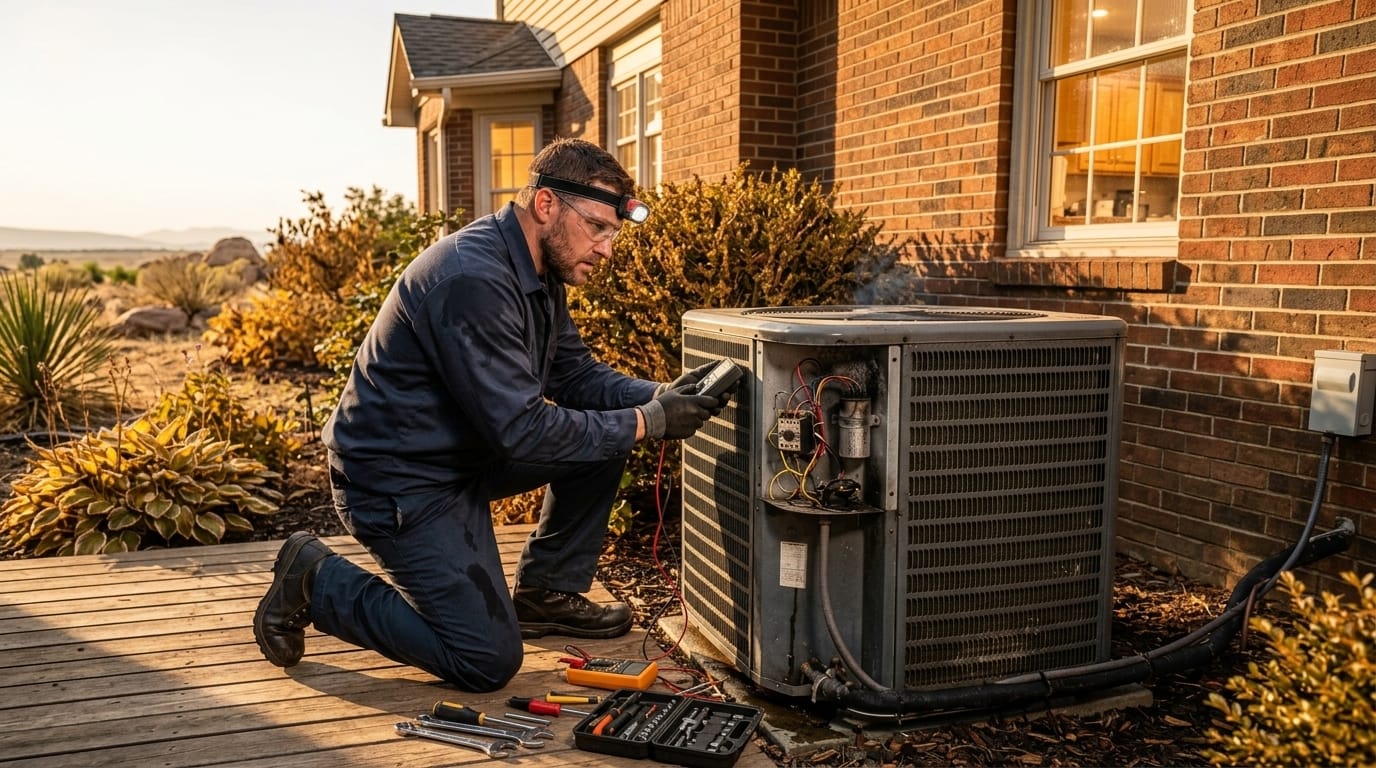
Testing these parts takes meters and training, so finding the failed one is AC repair work.
Turn the System Off While the Power Is Out
During a power outage, set the thermostat to Off. The same Ready.gov page advises turning off or disconnecting appliances and equipment while the power is out. With the thermostat off, the system will not try to start on every flicker when service comes back.
Once the power has been steady for several minutes, set the thermostat back to Cool. Then give the system time to run through its restart delay before you decide something is wrong.
If you use a smart thermostat, its app may show the system as offline until your home Wi-Fi reconnects. That message is about the network, not the air conditioner. Look at the thermostat screen itself to see whether it is calling for cooling.
What You Can Check Safely After the Power Returns
If the AC is still not working after the power outage and a few minutes of waiting, work through these checks. None of them need tools or an open panel.
- Thermostat screen: if it is blank, replace the batteries if it uses them. Then confirm the mode is Cool and the setpoint sits below the room temperature.
- Thermostat settings: some models restart with a default schedule, the wrong time or the system set to Off.
- Breakers: find the breakers labeled for the air conditioner and the furnace. If one has tripped, switch it fully off, then back on, one time only.
- Outdoor disconnect: look at the box on the wall near the outdoor unit and confirm nobody switched it off.
- Furnace switch: confirm the light-style switch on or near the furnace is on.
- Condensate pump: if a small pump lifts water from the furnace area to a drain, check that it has power and its tank is not full. One equipment maker's guide explains that an overflow switch can shut down the outdoor unit and the indoor blower when water backs up.
If the thermostat keeps losing its settings after power outages, consider thermostat installation.
A Herriman Scenario You Might Recognize
Picture a family in a Herriman home on a hot evening after a summer storm. The lights flicker several times before the power finally settles. The thermostat comes back on and the basement furnace blower moves air, but it never turns cool. Outside, the condenser hums for a few seconds, clicks off, and tries again a few minutes later. The fan blades never turn.
The running blower and the hum show that power and the cooling call are both reaching the equipment. The contactor is likely closing, since the compressor is trying to start. A hum without a spinning fan points to a run capacitor that the surge or the hard starts may have weakened. The repeated shutoffs suggest the compressor overload is tripping each time.
The right move is to set the thermostat to Off so the compressor stops straining, then call for service.
Safety Notes
- Reset a breaker only once: if it trips again, leave it off. A repeat trip points to a short or a failing motor.
- Keep equipment closed: a capacitor can hold a dangerous charge after the power is off, so leave the outdoor unit's service panel, the disconnect box and the main panel's inner cover closed.
- Keep water and electricity apart: if a condensate pump has overflowed, do not handle wet equipment that is still plugged in.
- Treat burning smells as an emergency: if you smell burning or see smoke near the outdoor unit, the furnace or the panel, get everyone outside, then call 911 from outside.
- Take carbon monoxide alarms seriously: if one sounds during or after a power outage, get everyone outside, then call 911 from outside.
- Keep generators outdoors: the Ready.gov generator safety guidance says to use a generator only outdoors, at least 20 feet from windows, doors and attached garages.
When to Call a Professional
Call for service when a breaker trips a second time, when the outdoor unit hums without the fan turning, or when it clicks on and off without starting. A thermostat that stays blank with fresh batteries and the breakers on can point to a blown control fuse or a failed transformer. An overflow switch that keeps tripping after the pump runs also needs a closer look.
On a hot night with no cooling at all, emergency AC repair may be the right call. If the house gets dangerously hot while you wait, treat it as urgent and follow the National Weather Service heat safety guidance.
Towers Plumbing can test the capacitor and contactor, check voltage at the outdoor unit, and trace the control circuit back to the thermostat. That shows whether the outage damaged a part or simply left the system in a tripped state.
Frequently Asked Questions
Why won't my AC turn on right after the power comes back?
A restart delay is a common reason. Many thermostats hold the compressor off for several minutes after a shutdown. If nothing starts after that, check the thermostat mode, the breakers and the outdoor disconnect.
Can a power outage damage my air conditioner?
The outage itself rarely does harm, but the return of power can. Surges and repeated flickers can weaken a capacitor, burn a contactor or blow a control fuse. Setting the thermostat to Off until power is steady lowers that risk.
Should I have my AC checked after a big storm?
If it runs normally, a check can wait for regular maintenance. If it makes new noises, runs longer than usual or trips a breaker, have it looked at soon. The ENERGY STAR maintenance checklist notes that faulty electrical connections can cause unsafe operation and reduce the life of major components.
Getting Your AC Back After a Power Outage
Before you call, write down what you noticed. Note how long the power was out, whether the lights flickered when it returned, and what the thermostat screen shows now. Note whether the indoor blower runs and whether the outdoor unit is silent, humming or clicking.
Record the breaker and disconnect positions, plus any burning smell or water near the furnace. Mention the thermostat model if you know it, and snap a photo of the thermostat screen and the breaker panel. Then reach Towers Plumbing through our contact page to set up a visit. With those notes in hand, a technician can go straight to the likely cause, confirm it, and explain the repair before any work begins.