
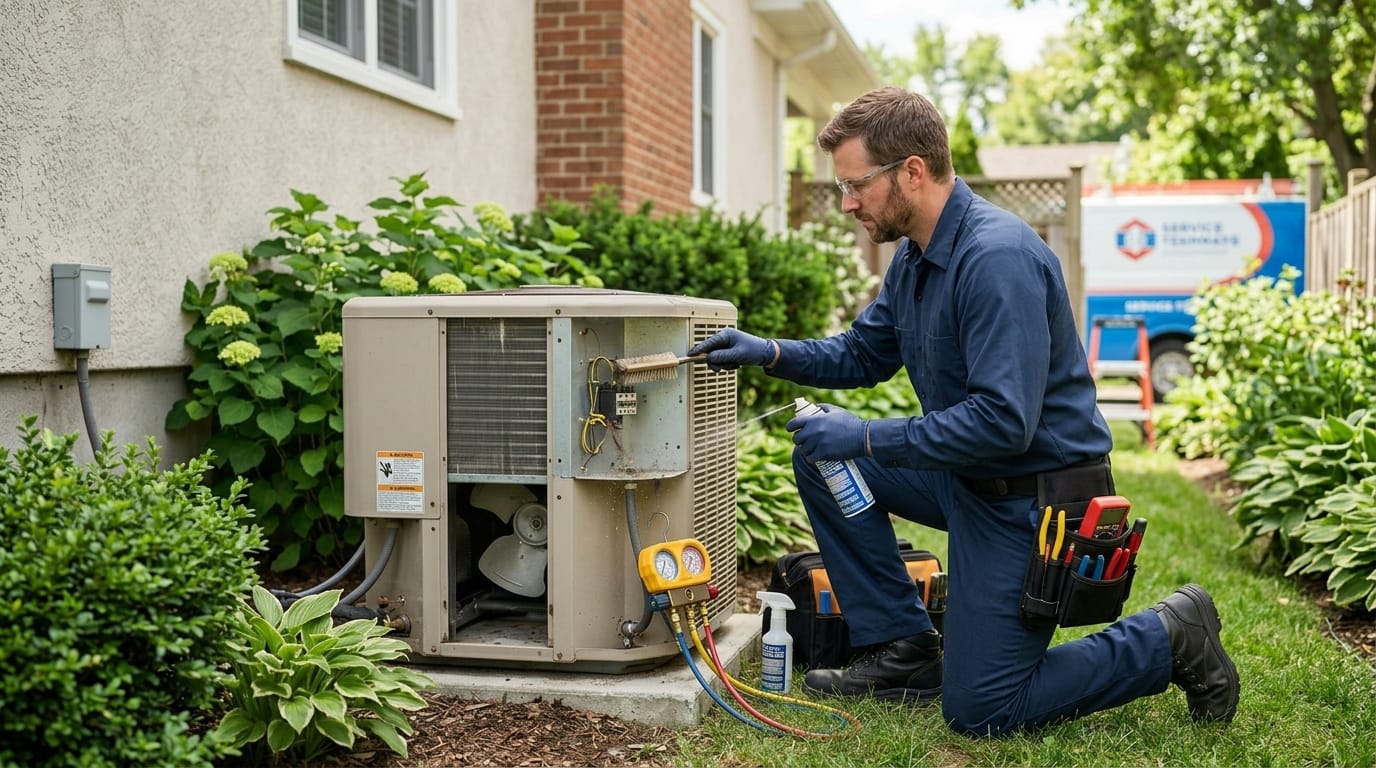
Spring is when many South Jordan households switch the air conditioner back on. If the air feels weak or the system runs and runs, a refrigerant leak is one of the first things to rule out. Refrigerant does not get used up, so a low charge means it escaped somewhere. Here is how leaks form, the signs to watch for, why a top-off is not a repair, and how the fix gets decided.
Refrigerant Is Not Used Up: How a Refrigerant Leak Develops
Central air moves heat with a sealed loop of refrigerant. Indoors, the evaporator coil sits on top of the furnace or air handler. Refrigerant boils inside it and absorbs heat from the air passing over it. The outdoor compressor pumps that vapor to the condenser coil, which releases the heat outside. The refrigerant returns as a liquid through the smaller copper line.
Nothing in that loop consumes the charge, so loss happens only through a breach. Common spots include pinhole corrosion in copper coil tubing, brazed joints, service port valve cores, and lines that rub against the cabinet as the unit vibrates.
As refrigerant escapes, evaporator pressure drops and the coil runs colder. Below freezing, moisture from the air freezes on the fins, and the ice blocks airflow. Returning vapor also cools the compressor, so a short charge adds strain there too.
Signs of a Refrigerant Leak and What You Can Check Safely
Several symptoms point to a low charge, especially in combination.
- Weak cooling: the system runs long cycles, but vent air feels only slightly cool.
- Ice on the lines: frost forms on the larger insulated copper line, called the suction line, or on the indoor coil.
- Hissing or bubbling: a larger refrigerant leak can hiss near the coil or along the line set.
- Oily residue: refrigerant carries compressor oil, so an oily, dusty stain on a copper joint can mark the escape point.
- Water near the furnace: melting coil ice can overflow the drain pan after the system shuts off.
A few checks are safe for anyone. Replace a dirty filter first, since a clogged filter can also ice a coil. Confirm the thermostat is set to Cool and the registers are open. Look for frost where the suction line enters the outdoor unit. Then read the outdoor nameplate, which usually lists the refrigerant type, according to the EPA homeowner FAQ.
Why a Top-Off Fails and What EPA Section 608 Requires
Adding refrigerant without finding the leak treats the symptom. The new charge escapes through the same opening, and the coil ices again. The same EPA FAQ advises homeowners to ask technicians to locate and repair leaks instead of topping off leaking systems.
Federal rules shape the job. Under Section 608 of the Clean Air Act, EPA's venting prohibition bars intentionally releasing refrigerant during service, repair or disposal. Anyone who opens the refrigerant circuit needs Section 608 technician certification.
EPA's leak repair requirements set formal repair deadlines only for appliances with a full charge of 50 pounds or more. Home systems usually hold less, but the venting ban and certification rules still apply. Older systems add one more factor: EPA notes that no new R-22 has been made or imported in the United States since January 1, 2020.
How Technicians Search for a Refrigerant Leak
A leak search starts with gauge readings and a close look. A technician measures pressures, superheat and subcooling, then checks joints, valves and coil tubing for oil stains. Several methods narrow it down from there.
- Electronic leak detector: a heated diode or infrared sensor sniffs along the coil, joints and line set.
- Bubble solution: a soap solution brushed on a suspect fitting forms bubbles where gas escapes.
- UV dye: some technicians add a dye that glows under an ultraviolet lamp, when the equipment maker allows it.
- Nitrogen pressure test: the refrigerant is recovered, then sections are pressurized with dry nitrogen to see which one loses pressure.
Evaporator leaks can be the hardest to reach, because the coil sits in a sealed cabinet above the furnace. After a repair, the system is evacuated, checked with a micron gauge and recharged by weight to the manufacturer's specification.
Repairing the Leak or Replacing the Coil
Once the leak is found, a handful of factors decide the fix.
- Where the leak is: a leaking valve core, flare nut or accessible brazed joint is usually a straightforward repair.
- How widespread it is: pinholes scattered through an evaporator coil often mean the coil needs replacing rather than patching.
- Refrigerant type: EPA says there are no drop-in replacements for R-22, so R-22 repairs usually mean recharging with reclaimed R-22.
- Match with the outdoor unit: a new coil must suit the condenser's refrigerant, capacity and metering device, such as a TXV or piston.
- Overall condition: compressor health, system age and past leaks all shape whether a repair makes sense.
The EPA FAQ also recommends having HVAC equipment evaluated by a professional once it is more than 10 years old. Towers Plumbing provides AC repair and can walk you through each option before any work begins.
A South Jordan Scenario You Might Recognize
Picture a family whose central air struggled on the hottest afternoons last summer. Late in the season, someone added refrigerant, and cooling improved for a while. Now, on one of the first warm days in April, the house cools slowly again. The filter is new and every register is open. After a long run, the suction line at the outdoor unit is coated in frost. A small puddle appears near the basement furnace after shutdown.
That pattern points to a refrigerant leak that the top-off only masked. A clean filter rules out the most common airflow cause of icing. Frost on the suction line and meltwater near the furnace suggest the evaporator coil is running below freezing. The next step is a leak search, starting at the indoor coil and its joints, before any more refrigerant goes in.
Safety Notes
- Leave the refrigerant circuit sealed: do not loosen fittings, cut lines or press on service port valve cores, since the refrigerant is under pressure.
- Skip the recharge cans: the EPA FAQ warns that products sold as "22a" refrigerant are highly flammable and not acceptable for home AC.
- Shut down an iced system: set the thermostat to Off so the coil can thaw, and lay towels near the furnace for meltwater.
- Leave electrical parts alone: the outdoor unit holds high-voltage wiring and capacitors, so panel work belongs to a technician.
- Burning smell or smoke: if you smell burning or see smoke from the furnace, air handler or outdoor unit, get everyone outside, then call 911 from outside.
When to Call a Professional
Call for service when ice returns after the coil thaws, even with a clean filter and open registers. Call as well if you hear hissing near the coil, find oily stains on copper joints, or notice cooling fading again after refrigerant was added. Any of these makes a refrigerant leak likely, and only a certified technician can open the system to confirm it.
An R-22 system that needs refrigerant deserves a careful look at repair versus replacement before the next charge. Spring is a good time for that conversation. The ENERGY STAR maintenance checklist recommends an annual pre-season check-up, with the cooling system checked in spring, including its refrigerant level. A spring AC maintenance visit can catch a slow leak before summer's long run times.
Frequently Asked Questions
Does an air conditioner use up refrigerant over time?
No. Refrigerant circulates in a sealed loop and is not consumed. If the charge is low, it either escaped through a leak or the system was undercharged at installation.
Is it safe to keep running an AC with a refrigerant leak?
Running on a low charge can ice the coil and strain the compressor. If you see ice or the air turns warm, switch cooling off and schedule a leak search.
Can I buy refrigerant and recharge the system myself?
No. The EPA FAQ states that Section 608 certification is required to recharge appliances. Refrigerant for these systems is sold only to certified technicians or the companies that employ them.
Get a Refrigerant Leak in South Jordan Tracked Down
Before you reach out, write down a few details. Note when cooling changed, where ice formed and how long the system ran before it appeared. Photograph any oily stains on copper joints. List past refrigerant additions with rough dates, and copy the model number and refrigerant type from the outdoor nameplate. If ice is present, keep cooling off until the visit.
Then contact Towers Plumbing through the contact page and share those notes. Towers Plumbing serves homes in South Jordan. With your notes in hand, a technician can start the leak search in the right place and explain the options before work begins.