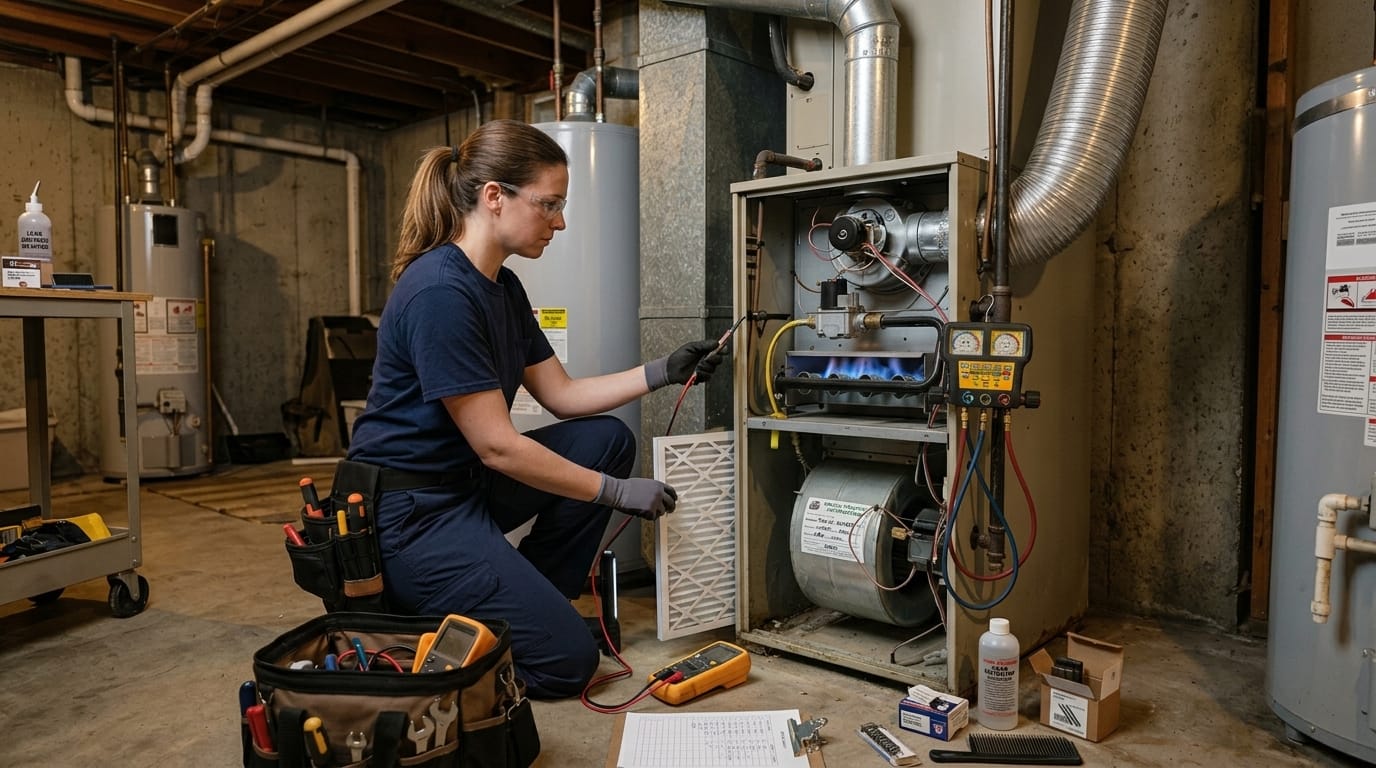
Furnace maintenance in a Salt Lake City home needs to examine the heating cycle, airflow and safety controls as well as the filter. A clean filter helps air move, but it cannot establish whether the burner lights correctly, the blower moves enough air or combustion gases leave through the intended vent. Those are separate parts of the system, and a fault in any of them can produce unreliable heat.
The useful question is what the inspection establishes about your furnace. Ask for findings tied to the equipment installed in your home, rather than assuming every furnace requires the same checklist. A fuel-burning furnace and an electric furnace have different heat sources, even when both distribute warmth through ducts.
Furnace maintenance connects airflow with heat production
The blower moves indoor air across the heat exchanger, the metal assembly that transfers heat while separating combustion gases from circulating air. If airflow becomes restricted, heat can build up inside the furnace faster than the blower carries it away. A high-limit control can then interrupt heating. The result may look like a furnace that starts normally but stops before the house warms.
A dirty filter is a possible restriction. A collapsed filter, obstructed return grille, dirty blower wheel or unsuitable replacement filter can also change airflow. Replacing the filter addresses only the condition at that location. It does not prove that the rest of the air path is open.
ENERGY STAR's maintenance checklist identifies electrical connections, controls and heating-system checks as distinct maintenance tasks. The exact inspection still depends on the furnace design and manufacturer instructions. Ask which observations were made and which tests were needed to confirm them.
What a professional assessment can distinguish
A thermostat sends a heating request; the furnace controls then manage startup, heat production and shutdown. In a gas furnace, ignition and flame sensing are part of that sequence. A flame sensor helps the control confirm that a burner flame is present. A dirty or failing sensor can interrupt operation, but repeated shutdowns can also have other causes.
A maintenance assessment may identify dirt or wear before the system fails. A repair assessment investigates an existing malfunction. Those purposes overlap, but they are not interchangeable. If your furnace already stops unexpectedly, tell the company when arranging service so that the symptom becomes part of the work scope.
For service context, review Towers Plumbing's furnace maintenance service. If the same blower and duct system also serves your air conditioner, the cooling services page provides related system information. A shared air path means an airflow concern can matter in more than one operating mode.
Contact Towers Plumbing to schedule a furnace assessment if the equipment already stops before rooms warm.
A hypothetical first-heating-day problem
Imagine a Salt Lake City homeowner replacing a visibly dusty filter before the first sustained heating use. The furnace starts, produces warm air and then shuts off while the thermostat still calls for heat. The homeowner assumes the new filter must have solved any maintenance concern, yet the pattern continues.
That situation calls for investigation of the sequence, not another random filter change. A technician might evaluate airflow, temperature rise, the blower and safety-control operation. The result could identify a restriction or a component fault; the symptom alone cannot select the repair. Keep a record of whether the blower continues after the heat stops, because that distinction helps describe the interruption.
Choose a visit focused on the existing shutdown if that is the actual problem. Routine maintenance makes more sense when the furnace operates normally and you want its condition reviewed before more frequent use.
What to observe safely before the appointment
Before furnace maintenance, gather observations the technician can use without opening the equipment:
- Check normal thermostat settings and whether furniture blocks accessible return or supply grilles.
- Read the filter size and equipment instructions if accessible without opening a service panel.
- Photograph an externally visible model label and note any fault message shown through the normal viewing area.
Leave burner adjustments, electrical testing and combustion testing to a professional. Do not bypass a limit control or repeatedly reset a furnace that locks out. If a carbon monoxide alarm activates, leave the building and follow emergency instructions. The EPA's carbon monoxide information explains why fuel-burning equipment and venting deserve attention.
Filter selection also deserves a system-specific discussion. The EPA guide to air cleaners distinguishes filtration performance from whether a system can accommodate a filter. A higher capture rating does not establish furnace compatibility by itself.
Questions about furnace maintenance
Does a new filter replace a maintenance visit?
No. It addresses one part of the air path. It does not evaluate ignition, venting, blower operation or the controls that manage heating.
Should a shutdown be described when booking?
Yes. Describe what starts, what stops and whether the thermostat remains below its setting. That information helps define a troubleshooting visit.
Is a safety-control trip proof of a failed control?
No. A control may be responding to another condition. The cause of the trip needs assessment before replacing the control or restoring operation.
Contact Towers Plumbing to arrange furnace maintenance in Salt Lake City. Describe any interruptions when scheduling and ask for an explanation of the findings, including whether routine maintenance or a separate repair is the appropriate next step.