A furnace blowing cold air on a January night in Salt Lake City needs attention fast. The blower is moving air, but the burners are not adding heat, or they keep shutting off. The cause may be a fan setting, a clogged filter or a safety switch doing its job. Here is what causes it, what you can check safely, and when to call.
How a Gas Furnace Ends Up Blowing Cold Air
A gas furnace runs the same sequence each time the thermostat calls for heat. The inducer motor starts and pulls combustion air through the heat exchanger, and a pressure switch confirms that draft. Then the igniter glows, the gas valve opens, and the flame sensor proves the burners lit. After a short delay, the blower sends warm air into the ducts.
If any safety switch opens during that cycle, the control board closes the gas valve. The blower may keep running to cool the heat exchanger, which is the usual pattern behind a furnace blowing cold air.
With the thermostat fan set to ON instead of AUTO, the blower also runs between heating cycles, moving room air that feels cool at the register. Switching the fan back to AUTO puts the furnace back in control of when the blower runs.
A Dirty Filter Can Trip the High-Limit Switch
The high-limit switch sits near the heat exchanger and opens when the cabinet gets too hot. Weak airflow from a clogged filter, closed supply registers or blocked return grilles is a frequent reason.
When the switch opens, the burners stop and the blower keeps running, so you get a furnace blowing cold air for several minutes. Once things cool, the burners light again, and that loop can repeat all night.
The ENERGY STAR maintenance checklist recommends inspecting, cleaning or changing filters once a month. Furnaces run long hours in January, and during winter inversions, which the Utah Department of Environmental Quality explains trap pollution near the ground, homes tend to stay closed up. Our air filter replacement service can help match a filter to your system.
Flame Sensor Problems and Ignition Lockout
The flame sensor is a thin metal rod that sits in the burner flame. The board passes a tiny current through the flame to prove fire is present. Over time, the rod picks up a dull coating that weakens that signal, so the board shuts the gas off seconds after the burners light.
Many furnaces retry a few times, then enter ignition lockout for a period set by the manufacturer. A worn igniter or a gas supply problem can cause the same lockout, and the blower may still run, leaving a furnace blowing cold air.
Many control boards report the fault with a blinking light, often visible through a small window in the blower door. A chart inside the door explains each flash pattern. Write the pattern down before you reset power, because a reset can clear it.
High-Efficiency Furnaces: Condensate and Pressure Switch Trouble
A high-efficiency, or condensing, furnace pulls so much heat from its exhaust that water forms inside it. That water drains through a trap and a condensate line, often to a basement floor drain or a condensate pump. If sludge clogs the trap or the pump fails, water backs up, and a float switch or the pressure switch keeps the burners from lighting.
These furnaces vent through two plastic pipes, and the pressure switch closes only when the inducer pulls a proper draft through them. After heavy snow, drifts or frost can block the pipe ends and stop that draft. The result is another furnace blowing cold air, usually with a pressure switch code.
Routine furnace maintenance includes clearing the condensate trap and checking the pressure switch hose, which can head off some winter shutdowns.
Safe Checks You Can Do First
None of these checks involve opening the burner compartment.
- Thermostat: set the mode to HEAT, the fan to AUTO, and the setpoint a few degrees above room temperature.
- Filter: with the furnace switch off, hold the filter up to a light. If little light passes through, replace it with the arrow pointing toward the furnace.
- Registers and returns: open closed registers and clear rugs or furniture off return grilles.
- Blower door: make sure it is fully seated, since a safety switch behind it keeps the furnace off.
- Status light: note the flash pattern before you touch anything else.
- Vent pipes: on a high-efficiency unit, gently clear snow or frost from the pipe ends by hand.
- Condensate drain: look for pooled water or a pump that hums but does not empty.
After that, one power reset is reasonable. If the furnace locks out again, call.
A Salt Lake City Scenario You Might Recognize
Picture a family whose basement furnace starts the evening fine, with warm air at every register. After several minutes the air turns cool, though the blower keeps running. Later the burners light again and the air warms back up. The cycle repeats all night, and the upstairs rooms fall behind the thermostat.
That pattern points to the high-limit switch. The burners light normally, which rules out most ignition problems, and they shut down only after running a while, which is how a limit trip behaves.
Airflow is the first suspect: a loaded filter, closed registers or blocked returns. In a Salt Lake City home with a finished basement, a register closed in a spare room is easy to miss. If those check out, the blower motor, a dirty evaporator coil above the furnace, or a duct restriction comes next.
Safety Notes
- Gas smell, smoke or a CO alarm: get everyone outside, then call 911 or the gas utility's emergency line from outside.
- Do not bypass safety switches: jumping a limit, pressure or rollout switch lets the furnace run in the very condition it exists to stop.
- Power off first: switch the furnace off before handling the filter or blower door.
- Leave gas parts alone: the gas valve, burners, igniter and flame sensor are technician work.
- Rollout codes: a flame rollout switch trips when flame escapes the burner area, so leave that code for a technician.
- Cold nights: if the house is losing heat on one of the coldest nights, treat it as urgent. The National Weather Service cold safety page has official guidance.
When to Call a Professional
Call when the basic checks do not bring the heat back, or when the furnace locks out again after one reset. Call as well if the status light points to a flame sensor, igniter, pressure switch or limit switch fault. Those parts guard against real hazards.
Water around a high-efficiency furnace, a condensate pump that runs without emptying, or an inducer that hums but will not start also point to a repair. So does a furnace blowing cold air after heating briefly, over and over.
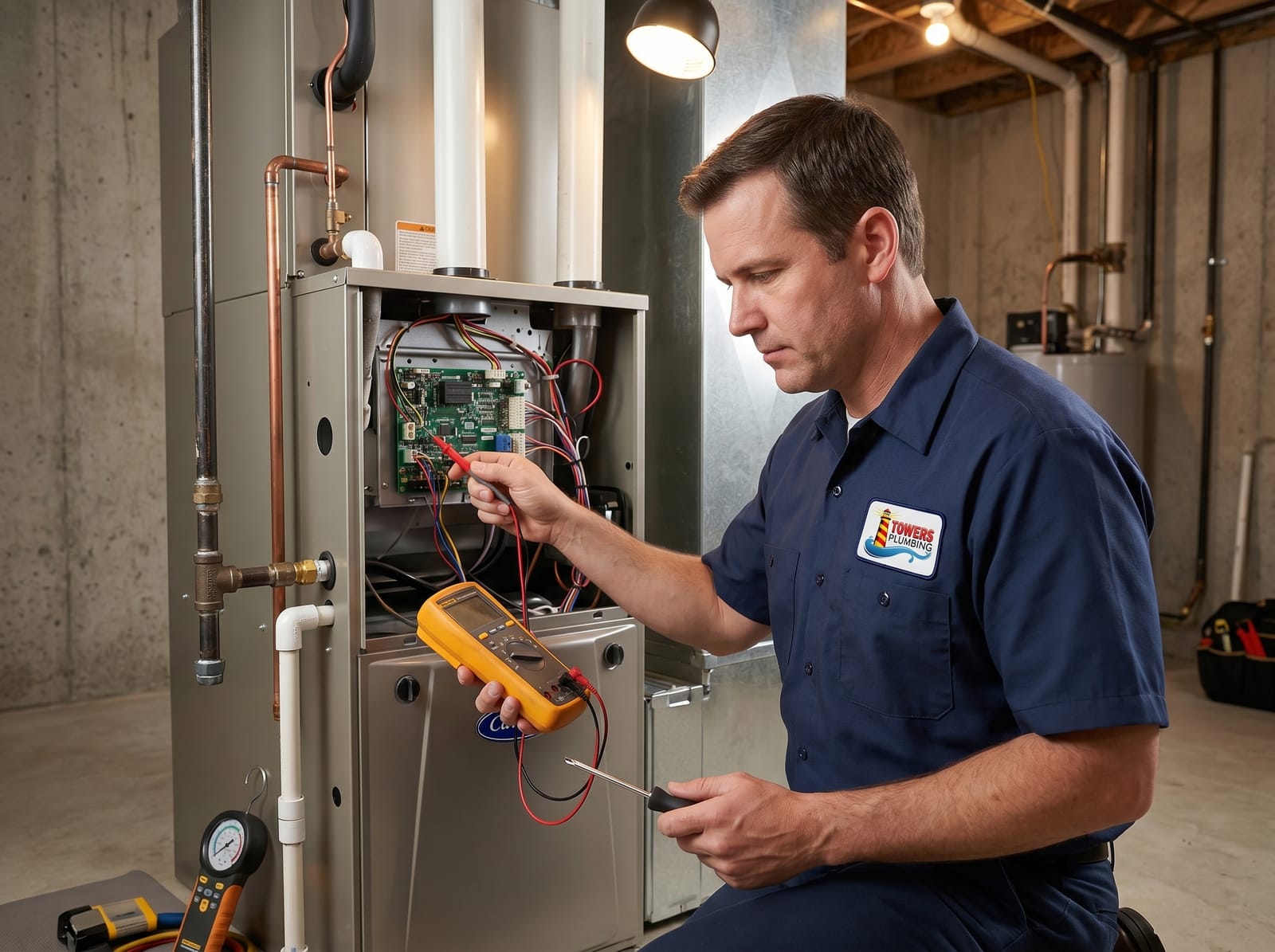
When your home has no heat, Towers Plumbing provides emergency furnace repair for gas furnaces that will not light or stay lit. A technician can read the fault history and test each safety switch instead of simply resetting it.
Frequently Asked Questions
Is it normal for a furnace to blow cool air for a minute?
Cooler air at the very end of a cycle is normal on many furnaces, because the blower runs briefly to pull leftover heat off the heat exchanger. A furnace blowing cold air for long stretches while the thermostat still calls for heat is not normal.
Can a new high-MERV filter make my furnace blow cold air?
It can. A filter too restrictive for your blower cuts airflow like a dirty one, and the high-limit switch may trip. The EPA's MERV rating guide suggests choosing as high a rating as your system fan and filter slot can accommodate.
Why does my furnace work after a reset, then quit again?
A reset clears the lockout, but the cause is still there. A coated flame sensor, a partial condensate clog or a weak inducer will fail the same way.
Get a Furnace Blowing Cold Air Checked
Before you call, write down what you noticed. Does the blower run nonstop, or do the burners light and then go out? How long does the furnace heat before the air turns cool? Note the flash pattern, the thermostat settings, and when you last changed the filter.
Mention whether it is a high-efficiency unit with plastic vent pipes, and take a photo of the furnace data label. Those details help a technician decide which switch or part to test first.
Then reach Towers Plumbing through our contact page. With your notes in hand, a technician can start with the most likely cause, confirm it with a test, and explain the repair before any work begins.