
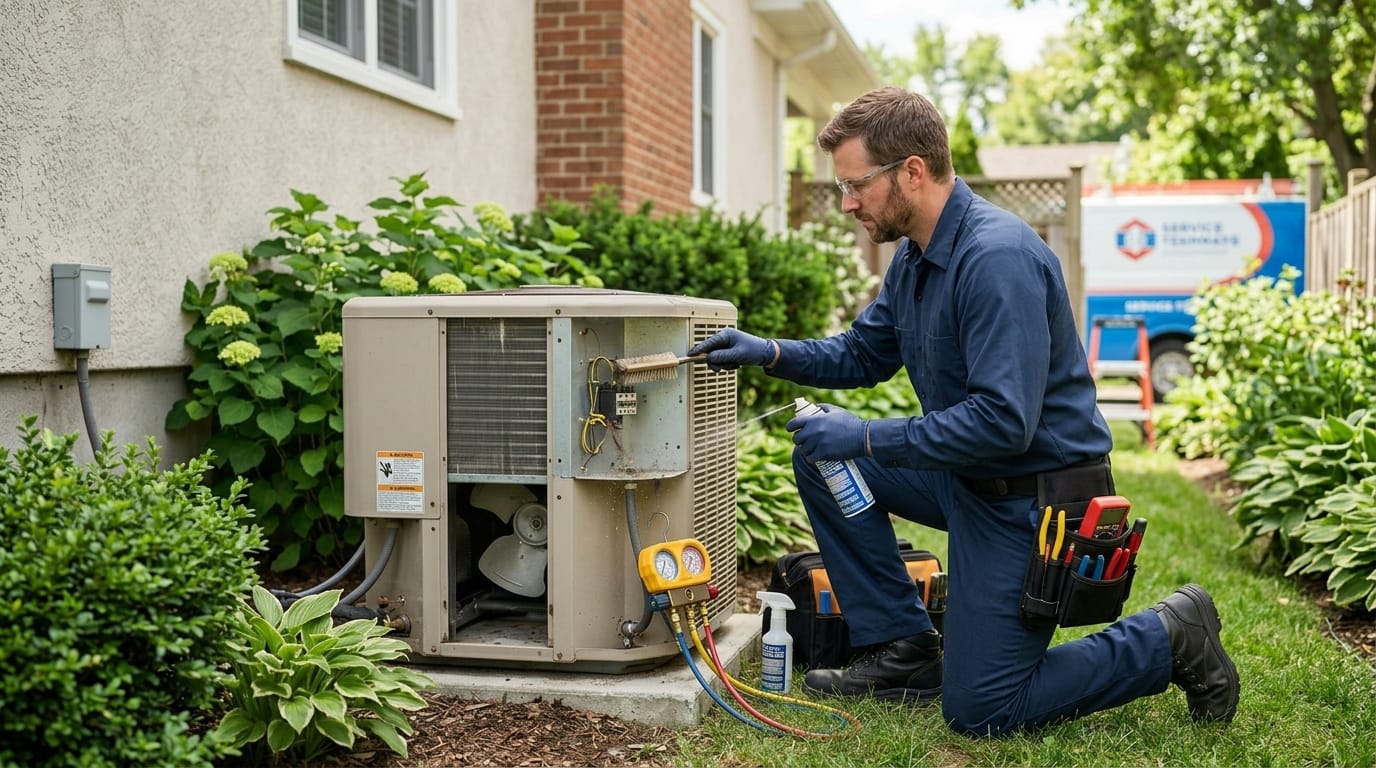
By July, the outdoor half of your air conditioner has spent weeks pulling in whatever floats past it. Cottonwood fluff, grass clippings and dust collect on its fins. A dirty condenser coil in a Murray home rarely fails all at once. It shows up as longer run times, weaker cooling on hot afternoons and, eventually, a compressor that shuts itself off. Here is how it happens and what you can safely do.
What the Condenser Coil Actually Does
A central air conditioner moves heat from inside the house to the outdoors. Indoors, the evaporator coil absorbs heat from the air the blower pushes across it. Refrigerant carries that heat outside to the compressor, which squeezes it into a hot, high-pressure vapor.
That vapor flows into the condenser coil, the thin aluminum fins and copper tubing that wrap around most of the outdoor unit. The condenser fan on top pulls outdoor air in through the coil and blows it out the top. The moving air carries heat away, and the refrigerant cools back into a liquid.
The coil works like a radiator, and a radiator wrapped in a blanket cannot do its job. That is why a dirty condenser coil affects the whole system.
How Fluff, Grass and Lint Clog the Fins
Because the fan pulls air in through the sides, anything light enough to float gets pressed against the coil's outer face. In early summer, cottonwood trees release seeds wrapped in white fluff that can drift across a yard for weeks. On a running unit, it mats onto the fins like felt.
Other debris adds to the layer:
- Grass clippings: a side-discharge mower aimed toward the unit blows clippings straight into the fins.
- Dust and ash: summer thunderstorms bring gusty winds that push grit into the coil, and in some smoky summers fine ash settles there too.
- Dryer lint: a dryer vent that exhausts near the unit sends lint toward the coil.
- Leaves and twigs: these pile up on the top grille and around the base.
Once a thin mat forms, it catches more debris faster.
What a Dirty Condenser Coil Does to Your System
When air cannot pass through the coil, the refrigerant cannot shed its heat, so its temperature and pressure climb. Technicians call this high head pressure. The compressor must push against that pressure, so it draws more current and runs hotter.
Cooling capacity drops too. Refrigerant that leaves the condenser too warm absorbs less heat at the evaporator coil, so the system runs longer and may fall behind on hot afternoons. ENERGY STAR's maintenance checklist notes that dirty coils reduce a system's ability to cool your home, make it run longer and shorten the life of the equipment.
Hot outdoor air already raises head pressure, so a dirty condenser coil hits hardest in July. An overheated compressor may shut down on its internal overload, and some units have a high-pressure switch that stops the system. Higher current draw can also trip the breaker. Repeated trips call for AC repair, not repeated resets.
What You Can Check Safely
Start with a look at the outside of the unit.
- Look at the fins: a gray or white film across the sides, or fluff you can pinch off, means the coil is coated.
- Check the top grille: leaves and seeds piled on top block the air leaving the fan.
- Listen: a steady fan and a low compressor hum are normal. A compressor that stops while the fan keeps turning is worth noting.
A gentle rinse is reasonable for many homeowners, but only with the power off and only as your manufacturer allows. Set the thermostat to off, pull the disconnect near the unit, and clear loose fluff by hand.
One manufacturer's coil cleaning tips describe lifting loose debris with a soft brush, then rinsing gently. Use a garden hose on a gentle setting, not a pressure washer, and keep water away from the electrical panel.
Keep Clearance Around the Outdoor Unit
The coil needs open space on the sides to pull air in and room above to push hot air out. Another manufacturer's condenser coil guide recommends keeping plants trimmed at least two feet from the unit on all sides and mowing so grass is thrown away from it.
Keep the top clear, too. Do not store things on the unit or cover it while it runs. A deck, overhang or low branch right above the fan can send hot air back down into the coil, raising head pressure much like dirt does.
Fences, tall grass and stacked garden supplies also cut into the air supply. Small changes in yard habits keep a dirty condenser coil from coming back as quickly after a cleaning.
A Murray Scenario You Might Recognize
Picture a family whose backyard sits downwind of several tall cottonwoods. In June, the fluff drifts across the lawn like light snow. By mid-July, the house cools well in the morning but falls behind the thermostat setting by late afternoon, with the system running almost nonstop.
One evening, the vents start blowing lukewarm air. Outside, the fan is still spinning, but the deeper hum of the compressor has stopped. An hour later, it restarts on its own. The sides of the unit look gray and felted.
That pattern points to a dirty condenser coil. The compressor is likely overheating from high head pressure, shutting off on its internal overload and restarting once it cools. Low refrigerant can cause similar symptoms, so a technician would clean the coil and then confirm the cause with pressure readings.
Safety Notes
- Cut power first: set the thermostat to off and pull the disconnect before you touch the unit or spray water.
- Leave the panels on: the electrical compartment holds a capacitor that can store a dangerous charge even with the power off.
- Mind the fan: keep hands out of the top grille, since the fan can start the moment power returns.
- Protect the fins: use gentle water pressure and do not scrape the coil with tools.
- Wear gloves: the fin edges are sharp.
- Reset a breaker only once: if it trips again, leave it off and call for service.
- Skip strong chemicals: use a coil cleaner only if your manufacturer's instructions call for one.
- Burning smell or smoke: get everyone outside, then call 911 from outside.
When to Call a Professional
Call when fluff is packed deep into the fins, when a rinse does not restore steady airflow, or when the compressor keeps shutting off on hot afternoons. Call as well if a breaker trips more than once, the fins are badly bent, or the unit hums without starting.
Professional coil cleaning goes further than a hose. With the power off, a technician can remove the top panel and fan and rinse the coil from the inside out, so debris leaves the way it came in. A coil cleaner loosens grime, and a fin comb straightens bent fins. Then the technician checks refrigerant pressures, current draw and the capacitor.
A yearly AC maintenance visit in spring catches buildup before peak heat. If the AC fails during a heat wave, treat it as urgent, and see the National Weather Service heat safety page.
Frequently Asked Questions
How often should the condenser coil be cleaned?
Most systems benefit from a professional cleaning once a year, ideally in spring before heavy use. Homes near cottonwoods, open fields or a dryer vent may need a gentle rinse in midsummer as well. Look at the fins once the fluff stops drifting.
Can a dirty condenser coil damage the compressor?
It adds real strain. High head pressure makes the compressor run hotter and draw more current, and repeated overheating wears it down over time. Cleaning the coil early is one of the simplest ways to reduce that stress.
Why does my AC keep up in the morning but not in the afternoon?
Outdoor heat peaks in the afternoon, and a coated coil sheds heat poorly just when it matters most. That pattern often points to a dirty condenser coil, though low refrigerant can look similar.
Get Your Outdoor Unit Cleaned Before the Next Heat Wave
Before you reach out, take a few notes. When does the house fall behind: all day, or only in the afternoon? Does the compressor stop while the fan keeps running? Write down any breaker trips, and take a photo of the coil's sides and top grille. Mention cottonwoods, a dryer vent or a mower path near the unit, and when the system last had a tune-up.
Then contact Towers Plumbing through our contact page to set up a visit, or read about the work Towers Plumbing does in Murray. With your notes in hand, a technician can confirm whether a dirty condenser coil is the cause and explain the cleaning before any work begins.