When your AC breaker keeps tripping, the panel is doing its job. It cuts power because something in the cooling system is drawing more current than the circuit can safely carry. In Provo, many people first notice it on the first hot afternoons of early summer, when the air conditioner works its hardest. Here is what usually causes it, what you can check without opening any panels, and when to hand it to a technician.
Why an AC Breaker Keeps Tripping
A central air conditioner usually runs on two circuits. The outdoor condenser, which holds the compressor and the condenser fan, sits on its own double-pole breaker. The indoor furnace or air handler that moves air through the house usually has a separate breaker. Knowing which one tripped narrows the search right away.
A breaker trips for two different reasons. Inside it, a heat-sensitive strip bends when too much current flows for too long, which is an overload. A magnetic trip reacts instantly to a sudden surge, such as a short circuit or a motor that locks up.
So timing matters. A breaker that trips the moment the compressor tries to start points to a different problem than one that holds for a while and then lets go. When a breaker keeps tripping, it is a symptom, not the fault itself. The real question is which part is pulling too much current, and why.
How the Failure Actually Happens
Nearly every cause comes down to one thing: a part draws more current than it should, or current leaks where it should not go.
- Weak capacitor or hard start: the run capacitor gives the compressor and fan motor the boost they need to start and keep turning. As it weakens, the compressor struggles to start and pulls heavy current much longer than normal. Some systems add a hard start kit to help an aging compressor get going.
- Worn compressor: worn bearings or tired windings make the compressor draw high current even while running. A winding that shorts to its metal shell trips the breaker instantly.
- Condenser fan motor: if the fan slows or stops, heat builds in the outdoor coil, pressure climbs and the compressor works harder. A seized fan motor can also overload on its own.
- Dirty condenser coil: dust, grass clippings and seed fluff packed into the outdoor coil trap heat and raise compressor current on hot afternoons.
- Loose or corroded wiring: a loose lug at the contactor, disconnect or breaker heats up, and heat at a connection can make a breaker trip early.
- Worn breaker: breakers age too. One that has tripped many times can start letting go below its rated load.
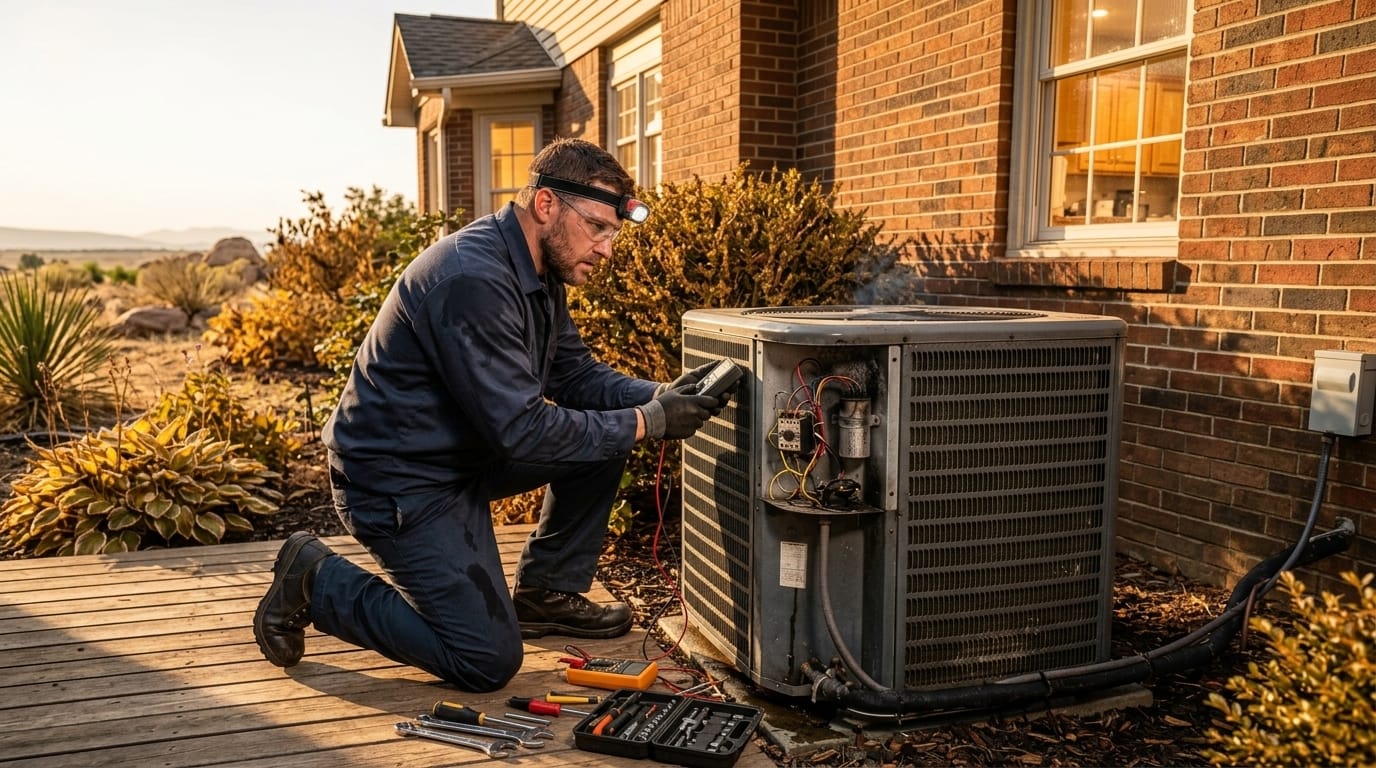
ENERGY STAR's maintenance checklist notes that faulty electrical connections can cause unsafe operation and shorten the life of major parts. Our AC repair technicians test capacitors, contactors and connections first, because they are quick to check before anyone condemns a compressor.
What You Can Check Safely
Start with the thermostat, not the panel. Set it to Off so the system does not try to restart the moment power returns.
- Find the tripped breaker: look for a handle sitting in the middle or off position, and read its label. Note whether it serves the outdoor unit or the furnace.
- Reset it once: push the handle fully to Off, then back to On. Wait a few minutes before setting the thermostat back to Cool.
- Watch and listen outside: stand near the outdoor unit when it starts, without opening it. A steady hum with the fan standing still, a loud clunk, or a buzz right before the trip are all useful clues.
- Look at the unit and its surroundings: check for clippings, leaves or plants crowding the coil. With the breaker off, you can clear debris from around it by hand.
- Check the indoor filter: replace it if it is clogged. It will not usually fix an outdoor breaker, but it rules out one airflow problem.
If the AC breaker keeps tripping after that single reset, leave it off. Resetting it again only forces a failing part to start into the same fault.
A Provo Scenario You Might Recognize
Picture a family whose air conditioner runs fine through the cool June mornings. On the first truly hot afternoon, the house starts warming, and someone finds the outdoor breaker tripped. They reset it once. The outdoor unit hums loudly, the fan blade barely turns, and soon the breaker clicks off again.
That pattern points toward the starting circuit. A hum with a slow or stalled fan is a common sign of a weak run capacitor, because one capacitor often serves both the fan motor and the compressor. It could also be a compressor that is hard to start, which draws heavy current until the breaker gives up.
When the breaker keeps tripping only in the heat, that fits both causes, since the compressor faces higher pressure then. A technician would test the capacitor and measure the starting current before deciding anything else.
Safety Notes
- Reset once only: each extra reset pushes more current through a part that is already failing and heats the wiring again.
- Do not upsize the breaker: the breaker is sized to protect the wire and to match the maximum breaker size printed on the unit's nameplate. A bigger breaker lets the wire overheat before it trips.
- Keep the panels on: the capacitor can hold a charge after power is off, and the contactor area carries high voltage.
- Do not hold or tape a breaker on: if a breaker keeps tripping, it is protecting the house.
- Burning smell or smoke: do not reset the breaker. Switch the thermostat to Off on your way out, get everyone outside, and call 911 from outside.
- Heat in the house: if the home is getting dangerously hot, treat it as urgent. The National Weather Service keeps heat safety tips worth reading before summer peaks.
When to Call a Professional
If the AC breaker keeps tripping after one reset, or trips the instant the compressor tries to start, it is time for a technician. The same goes for an outdoor unit that hums while the fan stands still, or a contactor that clicks and chatters. On a hot day with the house heating up, emergency AC repair is the right call.
A technician can measure the current each motor draws, compare it with the nameplate, test the capacitor, and check every connection for heat damage. If the compressor itself is failing, any repair that opens the refrigerant circuit belongs to a technician with EPA Section 608 certification.
The NFPA's electrical safety guidance lists frequent tripping of circuit breakers as a reason to call a qualified electrician. If the fault turns out to be the breaker or panel rather than the air conditioner, an electrician is the right person for that part.
Frequently Asked Questions
Is it safe to keep resetting the AC breaker?
Reset it once. If the breaker keeps tripping after that, leave it off and call. Each reset makes a struggling motor start into the same fault, and repeated heating can damage the wiring and the breaker itself.
Can I put in a bigger breaker so it stops tripping?
No. The breaker protects the wire, and its size has to match the wire and the maximum breaker size on the nameplate. A larger breaker hides the real problem and lets the wire run hotter than it was designed for.
Why does it only trip on hot afternoons?
On a hot day, the outdoor coil has a harder time shedding heat, so refrigerant pressure rises and the compressor draws more current. A weak capacitor, dirty coil or tired fan motor may cope on a mild morning and fail at the peak of the afternoon.
If my breaker keeps tripping, do I need a new AC?
Not necessarily. Capacitors, contactors, fan motors and loose connections are common, repairable causes. A compressor with a shorted winding is a bigger decision, and a technician's readings should guide it.
Next Steps When Your AC Breaker Keeps Tripping
Before you reach out, write down what you noticed. Which breaker tripped, the outdoor unit or the furnace? Did it trip the instant the system started, after a while, or only in the afternoon heat? Note any humming, clicking or buzzing, and whether the outdoor fan was turning.
Also note roughly how old the system is and when it was last serviced. Routine AC maintenance is when a technician checks the capacitor, contactor and wiring before the hottest weeks arrive.
Towers Plumbing serves homes across Provo and nearby communities. Send your notes through our contact page, and Towers Plumbing can send a technician who arrives knowing which breaker, which sounds and which timing to start with.