
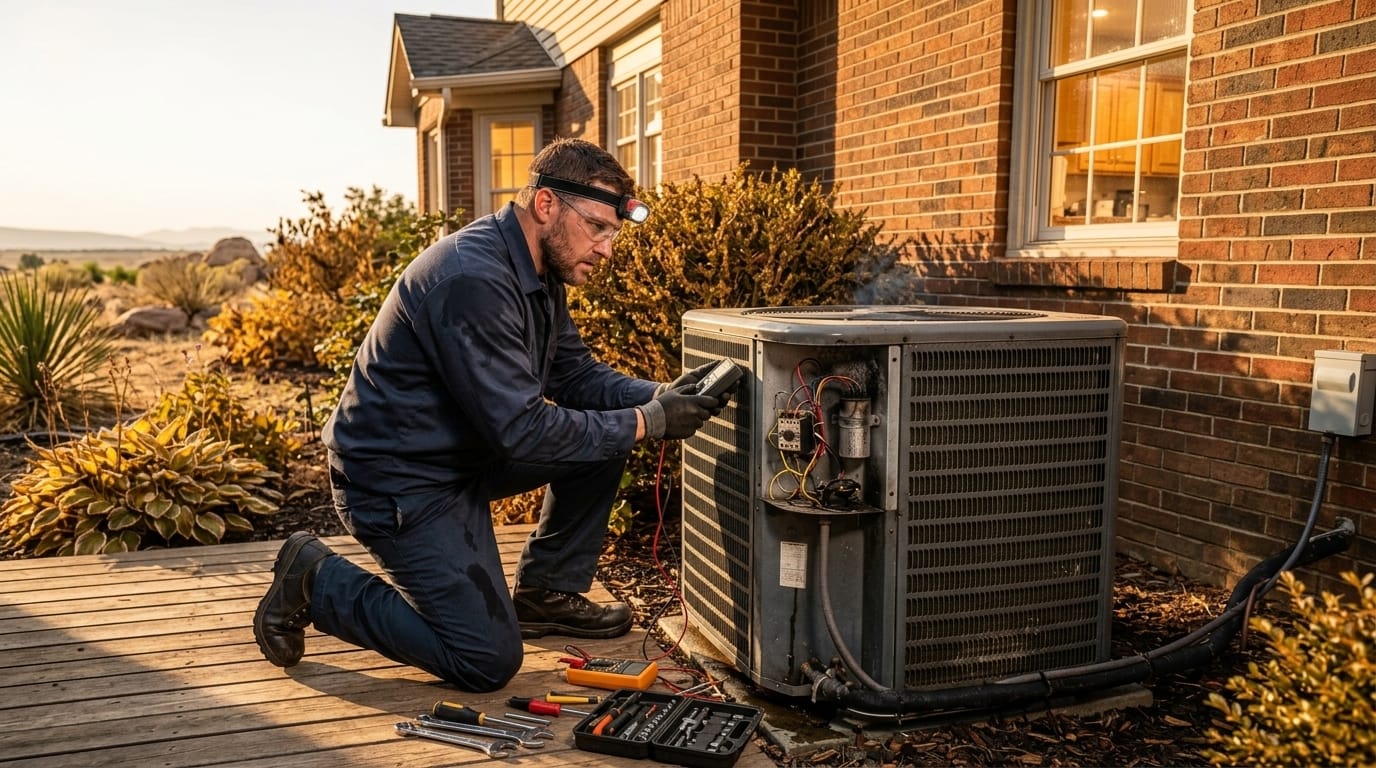
The first warm afternoon of spring is when many people learn their air conditioner has a problem. The indoor fan starts, but the vents deliver air no cooler than the room. An AC blowing warm air in a Provo home usually traces back to a short list of causes. Here is how the system works, what you can safely check, and when to call a technician.
Why an AC Ends Up Blowing Warm Air
A central air conditioner does not make cold. It moves heat. Refrigerant flows through a sealed loop between two coils. Indoors, the evaporator coil usually sits on the furnace or air handler, and the blower pushes house air across it. The cold refrigerant absorbs heat from that air, so the air leaving the registers is cooler.
Outside, the compressor raises the refrigerant's pressure and pumps it through the condenser coil, where the condenser fan pulls outside air across the coil to carry the heat away.
The indoor blower and the outdoor unit are powered separately, so the blower can keep moving air when nothing outside is removing heat. That is why a system blowing warm air often has a healthy fan. The fault sits between the thermostat, the outdoor unit, the refrigerant and the ducts.
When the Outdoor Unit Stays Silent
If the indoor fan runs but the outdoor unit makes no sound, the house is only recirculating its own air. Four parts sit in the power path to that unit.
- Breaker: the outdoor unit has its own breaker in the main panel. If it trips, the condenser loses power while the indoor blower keeps running.
- Disconnect: a small box near the condenser holds a pull-out block or switch. If it gets pulled or bumped, the unit will not start.
- Capacitor: this part helps the compressor and fan motor start and run. A weak one can leave the compressor humming or the fan sitting still.
- Contactor: this relay closes on a call for cooling and sends power to the compressor and fan. Pitted contacts or nesting insects can keep it open.
The breaker and disconnect are yours to check. Capacitors and contactors call for AC repair, since testing them means working around live, high-voltage parts.
Dirty Coils, Clogged Filters and Leaky Ducts
Other systems run but deliver lukewarm air because heat cannot move where it should.
The condenser coil wraps around the sides of the outdoor unit. After a winter outside, its fins can be matted with leaves and grit left by melting snow. ENERGY STAR's maintenance checklist notes that dirty coils reduce a system's ability to cool your home.
Indoors, the same filter usually serves the furnace all winter and the AC all summer, so by spring it may be loaded. A clogged filter starves the evaporator coil of airflow and can freeze it. Air filter replacement is one of the simplest fixes here.
If a supply duct has come apart in the attic or garage, cooled air escapes before it reaches the room. ENERGY STAR's duct sealing guide says about 20 to 30 percent of the air moving through a typical duct system is lost to leaks, holes and poor connections.
Refrigerant Leaks and Frozen Evaporator Coils
Refrigerant is not used up like fuel. It circulates in a sealed loop, so a system low on refrigerant has a leak. Common spots include the coils, brazed joints and service valves. With too little refrigerant, the evaporator cannot absorb enough heat, and the AC ends up blowing warm air.
Low refrigerant and weak airflow can both freeze the evaporator coil. When the coil runs too cold, moisture from the house air freezes on its fins, and the ice blocks even more airflow. You may see frost on the larger, insulated copper line at the outdoor unit, or water around the furnace as the ice melts.
Refrigerant work is not a homeowner task. Federal Section 608 rules prohibit venting refrigerant during service, and EPA requires technician certification for this work. A proper repair finds and fixes the leak before the system is recharged.
Safe Checks to Try First
These take a few minutes and need no tools.
- Thermostat mode: confirm it says Cool and the setpoint sits a few degrees below room temperature. Replace dim batteries.
- Fan setting: set the fan to Auto. On the On setting, the blower runs between cooling cycles, and that air can feel like the AC is blowing warm air.
- Heat pump homes: on a cool spring morning, Auto or Heat mode can still call for heat, so switch to Cool.
- Breaker: if the AC breaker is tripped, switch it fully off, then back on, one time only.
- Disconnect: make sure the block or switch by the outdoor unit is fully seated.
- Filter: hold it up to a light. If light barely passes through, replace it.
- Look and listen: does the outdoor fan spin, and is there a hum?
- Ice: if you see frost on the lines, set the thermostat to Off and the fan to On so the ice can melt.
A Provo Scenario You Might Recognize
Picture a family whose basement furnace ran long hours all winter. On the first warm weekend in April, they switch the thermostat to cool. The blower starts, and so does the outdoor unit, but the air at the registers is only a little cooler than the room. By evening the airflow feels weaker, and the larger copper line outside has a coat of frost.
That pattern points to a frozen evaporator coil. The outdoor unit is running, so power, the capacitor and the contactor are probably fine. The frost says the coil is running too cold, from weak airflow or low refrigerant. The filter is the first thing to check. If it is clean and the coil freezes again after a full thaw, a refrigerant leak moves to the top of the list.
Safety Notes
- Cut power first: pull the disconnect before you clear debris from the outdoor unit or rinse the coil.
- Leave the capacitor alone: it can hold a strong electrical charge even after the power is off.
- Reset a breaker only once: a breaker that trips again is signaling a fault, so leave it off.
- Rinse gently: use a garden hose on the outdoor coil, not a pressure washer, which can flatten the fins.
- Do not chip ice: a screwdriver or ice pick can puncture the coil and create a refrigerant leak.
- Watch for water: as a frozen coil melts, make sure the drain pan and condensate line carry the water to the floor drain.
- Burning smell or smoke: get everyone outside, then call 911 from outside.
When to Call a Professional
Call when the outdoor unit stays silent with the breaker and disconnect on, when a breaker trips twice, or when the compressor hums but will not start. Those signs point to a capacitor, contactor or motor that needs testing.
Call as well if the coil refreezes after a clean filter and a full thaw, or if you see oily residue on the refrigerant lines. A heat pump blowing warm air in Cool mode may have a stuck reversing valve, the part that switches it between heating and cooling. Rooms that stay warm while others cool well suggest a duct problem.
If an early warm spell arrives while the system is down, treat it as urgent, and see the National Weather Service heat safety page. A spring AC maintenance visit can catch weak capacitors and dirty coils before summer.
Frequently Asked Questions
Why is my AC blowing warm air when the outdoor unit is running?
If the condenser fan spins and the compressor runs, power is reaching the unit. Warm air then points to a dirty condenser coil, a clogged filter, a frozen evaporator coil or a refrigerant leak. Check the filter first, then have a technician measure the system's pressures.
Is it safe to keep running an AC that is not cooling?
Not for long. Low refrigerant or poor airflow can freeze the evaporator coil, and a struggling compressor can overheat. Set the thermostat to Off until a technician looks at it.
Can I add refrigerant myself?
No. Refrigerant work requires a certified technician, and adding refrigerant without fixing the leak only puts off the next failure.
Get Your AC Checked Before the Heat Arrives
Before you reach out, write down what you noticed. Does the outdoor unit run, hum or stay silent? Is the air warm at every register or only in certain rooms? Note any frost or water near the furnace, whether a breaker tripped, and when you last changed the filter.
Then contact Towers Plumbing through our contact page to set up a visit, or read about the work Towers Plumbing does in Provo. With your notes in hand, a technician can go straight to the likely cause of your AC blowing warm air and explain the repair before any work begins.